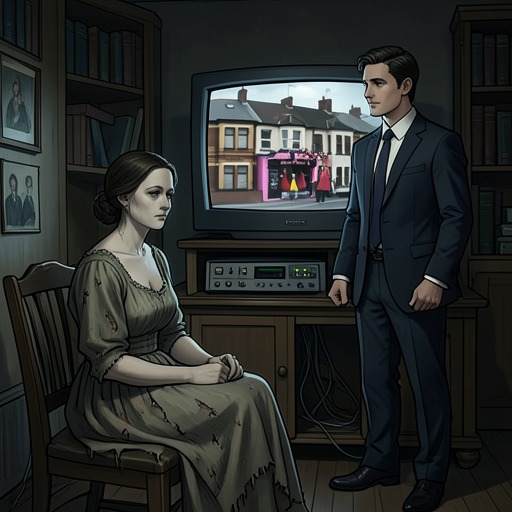
Libby’s mental-health crisis
The Death of Bunny MunroLibby’s mental-health crisis is rendered as an intimate but incompletely explained part of family life: Bunny Junior remembers his mother’s distress, and Bunny Munro recalls a marked change in her behavior after she encountered evidence of his infidelity. The narrative offers no diagnosis or account of treatment, and the phrase medical condition comes from Bunny rather than from an independent explanation. That restraint leaves the reader with concrete recollections, but not enough information to define Libby’s condition clinically or reduce it to a single cause.
Identity and limits of the account
The crisis is known through the memories of Libby’s husband and son, not through a sustained account from Libby herself. Bunny Junior’s recollection makes clear that her distress affected the household and unsettled his sense of who his mother was: on one occasion, while Bunny Munro was away, Libby came into her son’s bedroom, held him, and cried. He did not know how to respond and wondered where the mother he knew had gone. His memory registers both her need for comfort and his childhood bewilderment, without suggesting that he understood what was happening to her.
The narrative later has Bunny Junior recall that his father described Libby’s state as a medical condition. This is the only explicit medical framing in the supplied episodes. It establishes that Bunny Munro had used that description with his son, but it does not identify symptoms systematically, name a diagnosis, or explain whether Libby received care. The distinction matters: the account gives the family’s language for her distress, not a clinical history.
Distress within the home
Bunny Junior remembers seeing Libby in moments of visible emotional upheaval. He recalls her handling Bunny Munro’s shirts while crying, and another occasion when she sat on the kitchen floor in tears, her lipstick smeared across her face. The remembered details are domestic and specific: clothes, a bedroom, a kitchen floor. They show how the crisis entered ordinary household spaces, while the child’s recollection conveys the disorientation of witnessing behavior he could not make sense of.
These memories also complicate any simple picture of Libby as only distressed. Bunny Junior recalls that she smelled pleasant and felt soft, impressions of familiarity and physical comfort that remain alongside the unsettling episodes. His remembered mother is therefore not reducible to the moments when her behavior frightened or confused him. Tenderness and instability coexist in the child’s account, even though he lacks an explanation that could reconcile them.
Marriage and a change in behavior
Bunny Munro’s recollection connects a later shift in Libby’s behavior with his own betrayal. She discovered him with another woman who was unconscious, and he remembers her looking at him and then leaving without confronting him. The scene is filtered through Bunny Munro’s memory and his culpability; it supplies no direct account of Libby’s thoughts or of what she understood beyond what she saw.
When Bunny Munro returned home the following morning, he perceived Libby as changed. He recalls that she no longer challenged him about the incident, spent much of her time watching television, sitting around, and sleeping, and continued to have sex with him. His recollection presents withdrawal and passivity where he had expected anger, but does not establish that the discovery alone caused her crisis or explain how she experienced the marriage. The contrast is significant precisely because Bunny Munro tells it from the position of the person whose conduct helped create the circumstances of the scene. His surprise at her response does not amount to understanding it.
Memory, absence, and the family bond
After Libby’s death, Bunny Junior is troubled by the fading of her image. He can preserve factual knowledge in his encyclopedic memory, yet finds it increasingly difficult to remember his mother’s face. When he tries to hold onto a shared childhood scene at St Ann’s Well Gardens, he can picture himself swinging but cannot clearly recover who is pushing him. The gap turns a remembered moment of play into an image of separation: the activity survives, while the person who made it possible becomes indistinct.
Bunny Junior tries to arrange shared memories like exhibits in the Booth Museum, fixed and preserved against loss. Yet the comparison also emphasizes the limits of preservation: a carefully stored scene cannot restore Libby’s living presence. Later, in the fog near the Punto, he sees her in the Orange dressing gown and speaks with her. The encounter belongs to his experience of bereavement, not to evidence that defines Libby’s earlier condition. It gives the boy a form for expressing longing and remorse, while allowing the narrative to keep the distinction between remembered mother and imagined presence open.
Bunny Munro, too, sees Libby after her death, but their encounters take a different emotional shape. At the public gathering, he asks her forgiveness; when he asks whether she has been haunting him, she denies it. The exchange unsettles his assumption that her appearances have been directed at him. Together, the son’s consoling vision and the husband’s troubled encounter show how Libby remains present in the family’s grief without making her mental-health crisis a complete explanation of who she was. The narrative preserves the limits of what either man knows: her distress is remembered, her own account is absent, and the meaning of her posthumous appearances remains unresolved.